mirror of
https://github.com/Nycto/DelaunayNim
synced 2026-01-14 15:21:44 +00:00
No description
| .github/workflows | ||
| bin | ||
| src | ||
| tests | ||
| .gitignore | ||
| delaunay.nimble | ||
| LICENSE.md | ||
| nim.cfg | ||
| README.md | ||

DelaunayNim


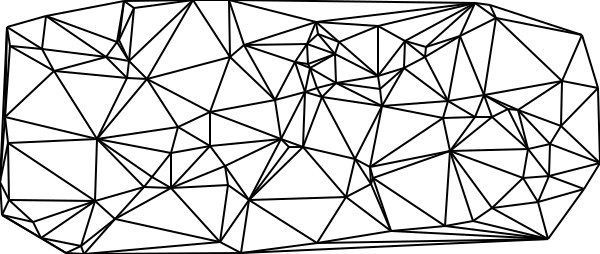
A Nim library for calculating the Delaunay Triangulation of a set of points. This is accomplished using a divide and conquer algorithm, as described here:
http://www.geom.uiuc.edu/~samuelp/del_project.html
Quick Example
import delaunay

# Points can be any object with an `x` and `y` field
let points: seq[tuple[x, y: float]] = @[
    (x: 25.0,  y: 183.0),
    (x: 189.0, y: 187.0),
    (x: 34.0,  y: 169.0),
    (x: 149.0, y: 136.0),
    (x: 78.0,  y: 105.0),
]

for edge in triangulate(points):
    echo edge
That app outputs the following:
(a: (x: 25.0, y: 183.0), b: (x: 34.0, y: 169.0))
(a: (x: 25.0, y: 183.0), b: (x: 189.0, y: 187.0))
(a: (x: 34.0, y: 169.0), b: (x: 78.0, y: 105.0))
(a: (x: 34.0, y: 169.0), b: (x: 149.0, y: 136.0))
(a: (x: 34.0, y: 169.0), b: (x: 189.0, y: 187.0))
(a: (x: 78.0, y: 105.0), b: (x: 149.0, y: 136.0))
(a: (x: 149.0, y: 136.0), b: (x: 189.0, y: 187.0))
Full Example
A full example can be found here: https://github.com/Nycto/DelaunayNim/blob/master/bin/createSvg.nim
That little binary accepts a list of points and outputs an SVG of the triangulated grid. You can use it like this:
seq 100 \
    | awk 'BEGIN { srand(); } { print int(rand() * 500) " " int(rand() * 500) }' \
    | ./bin/createSvg \
    > example.svg
License
This library is released under the MIT License, which is pretty spiffy. You should have received a copy of the MIT License along with this program. If not, see http://www.opensource.org/licenses/mit-license.php