| .github/workflows | ||
| doc/img | ||
| src | ||
| tests | ||
| .dir-locals.el | ||
| .gitattributes | ||
| .gitignore | ||
| config.nims | ||
| LICENSE | ||
| ntangle.nimble | ||
| README.org | ||

NTangle
- What is Tangling
- Why
ntangle? - Installation
- Features
- Screenshot
- Usage
- Org mode file samples for tangling
- Org Tangle Syntax
- Development
- History
- Other Org tangling implementations
Command-line utility for Tangling of Org documents — programmed in Nim.

What is Tangling
From Org Manual – Extracting source code:
Extracting source code from code blocks is a basic task in literate programming. Org has features to make this easy. In literate programming parlance, documents on creation are woven with code and documentation, and on export, the code is tangled for execution by a computer.
Org facilitates weaving and tangling for producing, maintaining, sharing, and exporting literate programming documents. Org provides extensive customization options for extracting source code.
When Org tangles
srccode blocks, it expands, merges, and transforms them. Then Org recomposes them into one or more separate files, as configured through the options. During this tangling process, Org expands variables in the source code, and resolves any Noweb style references (see Noweb reference syntax).
You can visit the same Org manual section from within Emacs by going
to this Info manual node: (org) Extracting Source Code.
Why ntangle?
While the tangling of Org documents works great from within Emacs, it can be quite a bit slow for large Org documents. This project aims to provide almost the same tangling functionality at a much higher speed.
You do not need Emacs or Org mode installed to use ntangle.
Installation
nimble can be used to install ntangle. This utility ships with Nim
installations. Think of it as the equivalent of the Python pip.
See choosenim installation to install nim and nimble.
To install ntangle:
nimble install ntangle
Above installs the binary in the ~/.nimble/bin/ directory.
Features
Tangling minus Noweb [7/8]
- Understands global tangle header-args in
#+propertykeywords - Understands tangle header-args directly above Org source blocks
-
Understands tangle subtree property drawer header-args
- Rudimentary parsing of the property drawer
header-args.
ntangledoes not check the validity of the property drawer (i.e.:PROPERTIES:appears immediately after the heading, and it ends with:END:, and that the properties are only between them, etc.). Alsoheader-argsis treated the same asheader-args+for simplicity for now. - Treat
header-argsvsheader-args+values correctly.
- Rudimentary parsing of the property drawer
header-args.
- Understands the precendence order of the tangle header-args when a mix of global and source block header-args are used
- Language-specific header-args (e.g.
#+property: header-args:nim
:tangle yes
) - Concatenating multiple source blocks to the same tangled file
- Respects comma-escaping in source blocks
- Removes common indentation, but also retains the indentation where needed
Supported header-args switches [5/7]
:tangle:padline:shebang:mkdirp:tangle-mode:comments:no-expand
Noweb [0/1]
- Noweb support. I sorely miss the lack of
nowebsupport.. I use it heavily ineless.
/There is no plan to support Org Babel functions with Noweb, like evaluating code blocks during tangling, etc. (just use Emacs for those :D)./
Supported header-args switches for Noweb [0/3]
:noweb:noweb-ref:noweb-sep
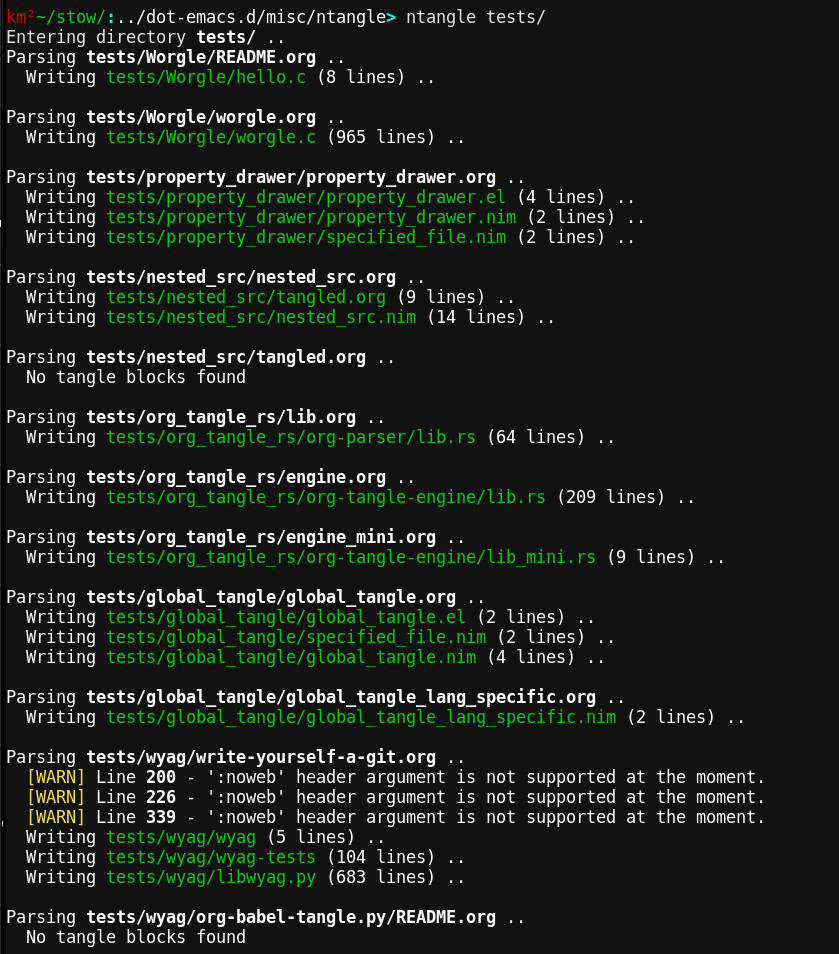
Screenshot
Usage
Add one or more Org files (files with names ending in ".org") or
directory names after the ntangle command. If directory names are
added, only the files in there with names ending with ".org" will be
parsed.
ntangle <FILE.org>
or a list of files:
ntangle <FILE1.org> <FILE2.org> ..
or a list of directories:
ntangle <DIR1> <DIR2> ..
or a mix of lists of files and directories:
ntangle <FILE1.org> <DIR1> <FILE2.org> <DIR2> ..
The tangled files will be created in paths relative to the source Org file.
Org mode file samples for tangling
You can find samples of the supported Org mode tangling in the test directory of this project.
Org Tangle Syntax
ntangle expects the Org files to use the header-args property
syntax used in Org mode 9.0 and newer. There was a minor syntax change
with header-args property in Org 9.0 (see ORG-NEWS).
So if you used the below in Org 8.x and older:
# Deprecated syntax
#+property: tangle yes
Refactor that to:
# Org 9.0 syntax
#+property: header-args :tangle yes
Similarly, refactor a property drawer from:
# Deprecated syntax
* Some heading
:PROPERTIES:
:tangle: yes
:END:
To:
# Org 9.0 syntax
* Some heading
:PROPERTIES:
:header-args: :tangle yes
:END:
Development
Below assumes that you have nim and nimble installed.
Building
git clone https://github.com/OrgTangle/ntangle
cd ntangle
nimble build # creates the ntangle binary in the same directory
# nimble build -d:release # same as above but creates an optimized binary
Testing
# cd to the git repo dir
./tests/test.sh
History
I was motivated to start this project after reading about the
org-babel-tangle.py Python project by @thblt.
I wanted to just see how easy it was to translate a Python script to Nim (it was very easy!), and from there, this project started snowballing, gathering features of its own :).